- What is diarrhoea in children?
- What causes diarrhoea in kids?
- Signs and symptoms of diarrhoea in children
- Dehydration — the most serious risk
- ORS — the most important treatment for diarrhoea in children
- What to feed a child with diarrhoea
- Full home treatment guide
- Diarrhoea in babies — special guidance
- Chronic diarrhoea in children
- Common myths about diarrhoea in children debunked
- How to prevent diarrhoea in children
- Frequently asked questions
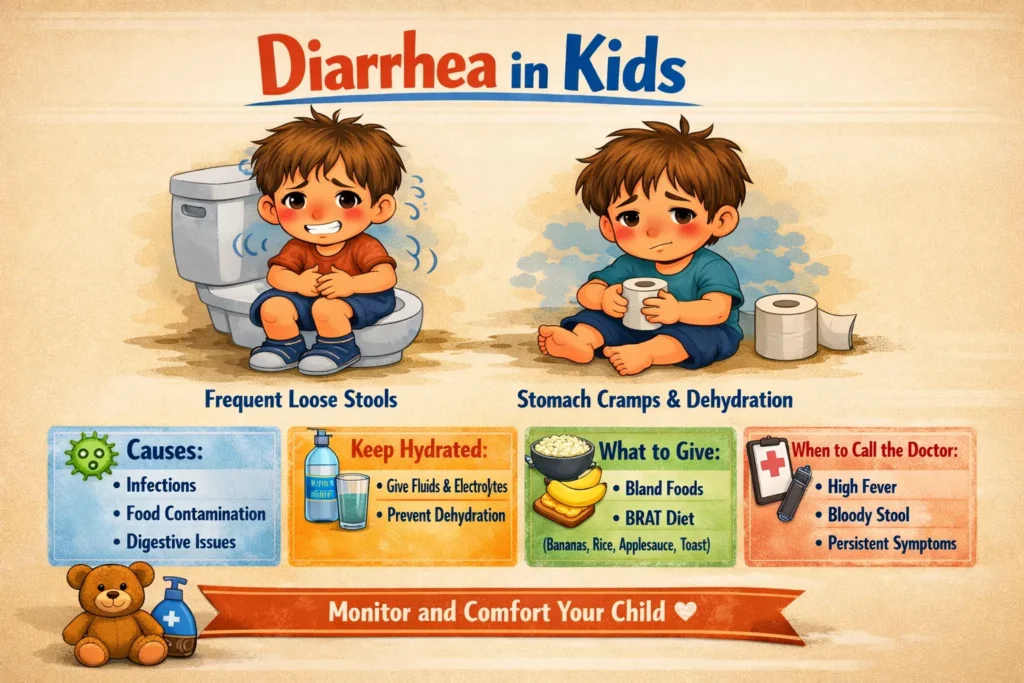
- When to call the doctor or go to the emergency room
Click any section to jump directly to it.
If you are a parent, diarrhoea in children is something you will almost certainly deal with multiple times before your child starts school. It is one of the most common illnesses in childhood worldwide — accounting for nearly 9% of all hospital admissions for children under 5 in the United States alone, and causing over 1.2 million child deaths globally each year, almost all from preventable dehydration.
The good news is that the vast majority of cases of diarrhoea in kids are mild, self-limiting, and resolve within a few days with proper home care. But knowing how to manage it correctly — what to give your child to drink, what to feed them, how to spot dehydration early, and when to seek medical help — makes all the difference between a rough few days at home and a trip to the emergency room.
This complete guide covers everything parents need to know about diarrhoea in children: the causes, symptoms, the correct use of oral rehydration solutions, foods to give and avoid, special guidance for babies, and every warning sign that tells you it’s time to call a doctor.
What is diarrhoea in children?
Diarrhoea in children is medically defined as three or more loose, watery stools per day. It is important to note that one or two softer stools are not diarrhoea — especially in breastfed infants, whose stools are normally quite loose and seedy. Diarrhoea becomes a concern when the number of bowel movements increases significantly from the child’s normal pattern and the consistency becomes watery or very loose.
Diarrhoea can be acute (lasting under 2 weeks — the most common type) or chronic (lasting more than 2 weeks, which always requires medical investigation). This guide focuses primarily on acute diarrhoea, which accounts for the vast majority of cases in children.
What causes diarrhoea in kids?
Understanding what is causing your child’s diarrhoea helps you make informed decisions about treatment and whether antibiotics or other medicines are needed. The overwhelming majority of cases have a simple, self-limiting cause:
Viral gastroenteritis — the most common cause
Viral gastroenteritis — commonly called the “stomach bug” or “stomach flu” — is by far the most frequent cause of diarrhoea in children. It typically causes a sudden onset of watery diarrhoea, often accompanied by vomiting, stomach cramps, and sometimes a low fever. It spreads very easily between children, especially in nurseries, schools, and daycare centres.
Rotavirus was historically the leading cause of severe diarrhoea in young children worldwide, but a safe and effective rotavirus vaccine is now available for infants in most countries and has dramatically reduced hospitalisations. Norovirus is extremely contagious and can sweep through families and schools within hours — it causes sudden explosive diarrhoea and vomiting that typically lasts 1–3 days.
Bacterial infections
Bacterial diarrhoea in children is less common than viral, but it tends to be more severe and more likely to contain blood or mucus in the stool. It is more commonly linked to contaminated food or water and is more likely to require antibiotic treatment if a specific bacteria is identified.
Food-related causes
Certain foods and dietary habits commonly trigger diarrhoea in children without any underlying infection. Too much fruit juice — particularly apple, pear, or grape juice — is one of the most common overlooked causes of ongoing loose stools in toddlers. The high fructose and sorbitol content pulls water into the bowel, causing diarrhoea.
Other causes of diarrhoea in children
- Antibiotic use — many antibiotics disrupt the gut’s natural bacteria and cause mild diarrhoea as a side effect; this is not an allergic reaction and the antibiotic should be continued unless a doctor advises otherwise
- Parasitic infections — Giardia lamblia is the most common parasitic cause; it causes prolonged, foul-smelling, greasy diarrhoea and requires specific anti-parasitic treatment
- Toddler’s diarrhoea — a common and harmless condition in children aged 1–4 where 3–6 loose stools per day occur without any pain or growth problems; often linked to too much juice or too little fat in the diet
- Lactose intolerance — temporary or permanent inability to digest milk sugar causes loose stools, bloating, and gas after dairy consumption
- Inflammatory bowel disease (IBD) — Crohn’s disease and ulcerative colitis can cause chronic diarrhoea with blood and mucus in children; these require specialist investigation
- Coeliac disease — an immune reaction to gluten that damages the gut lining, causing chronic diarrhoea, poor growth, and nutritional deficiencies
- Teething — a very common myth; teething does not directly cause diarrhoea. Any significant diarrhoea in a teething baby has another cause
Signs and symptoms of diarrhoea in children
The symptoms of diarrhoea in children vary depending on the underlying cause, but common accompanying signs include:
- Frequent loose or watery bowel movements — 3 or more per day; can be very sudden and urgent in viral gastroenteritis
- Stomach pain and cramping — often comes in waves just before a bowel movement and improves afterwards
- Nausea and vomiting — especially common in viral gastroenteritis; the combination of vomiting and diarrhoea greatly accelerates fluid loss
- Fever — a low-grade fever alongside diarrhoea suggests a viral infection; a high fever with diarrhoea containing blood or mucus is more suggestive of a bacterial infection
- Blood or mucus in the stool — this is never normal and always warrants a call to the doctor; it may indicate a bacterial infection, inflammatory bowel disease, or intussusception
- Bloating and gas — particularly associated with food intolerances, parasitic infections, or lactose intolerance
- Nappy rash — the acidic nature of frequent loose stools causes rapid and painful nappy rash in babies and toddlers; barrier cream with every nappy change is essential
Dehydration — the most serious risk
Dehydration is the number one complication of diarrhoea in children — and the reason diarrhoea kills over a million children worldwide every year, almost exclusively in places without access to oral rehydration solutions. Young children — especially infants and toddlers — can become severely dehydrated in less than 24 hours during an episode of significant diarrhoea.
Every parent must know how to recognise the three levels of dehydration and what to do at each stage:
Check your child’s urine colour. Pale straw-yellow = well hydrated. Dark yellow or amber = not enough fluid. No urine for 8+ hours = seek medical help urgently. You can also gently pinch the skin on the back of the hand — in a well-hydrated child it springs back instantly. Slow to return means dehydration. And always check for tears during crying — a child who cries without tears is significantly dehydrated.
ORS — the most important treatment for diarrhoea in children
Oral Rehydration Solution (ORS) is the single most important treatment for diarrhoea in children. It is not an anti-diarrhoea medicine — it does not stop the diarrhoea. What it does is replace the exact combination of water, sugars, and electrolytes (salts) that are lost in diarrhoeal stools, preventing the dehydration that makes diarrhoea so dangerous.
ORS is available without a prescription at most pharmacies and supermarkets worldwide under brand names like Pedialyte, Dioralyte, Rehydrat, and others. Generic store-brand versions are equally effective and often much cheaper. It comes as a liquid, a powder to dissolve in water, and even as ice popsicles for older children.
Give ORS in small, frequent amounts — not large amounts at once. Large volumes given quickly to a child who is already vomiting will usually come straight back up. Start with one to two teaspoons every few minutes and gradually increase. The goal is to replace what is lost in each loose stool.
Sports drinks, cola, lemonade, undiluted fruit juices, and sweetened drinks all have far too much sugar and not enough salt to rehydrate a child effectively. Their high sugar content actually draws more water into the bowel and can worsen diarrhoea. Plain water alone is also insufficient for babies and toddlers — it does not replace the electrolytes lost in stool. ORS is specifically formulated to be absorbed optimally. There is no substitute.
What to feed a child with diarrhoea
One of the most important — and most misunderstood — aspects of managing diarrhoea in kids is nutrition. The old advice to “rest the gut” and avoid all food has been comprehensively disproven. Current paediatric guidance from the WHO and major children’s hospitals worldwide is: continue feeding your child as normally as possible.
Children who continue eating recover faster from diarrhoea than those who are starved. Food provides the nutrients the gut lining needs to repair itself, and continued nutrition prevents the muscle weakness and immune suppression that comes from going without food during illness.
- Plain white rice or rice porridge
- Boiled potatoes or mashed potato
- Plain crackers or dry toast
- Banana — firms stools and replaces potassium
- Plain boiled chicken or fish
- Yogurt — contains probiotics that help recovery
- Plain pasta or noodles
- Applesauce (unsweetened)
- Carrots (boiled)
- Breast milk or regular formula for infants
- Fruit juices — worsen diarrhoea significantly
- Sports drinks or fizzy drinks
- Sugary sweets or desserts
- Fried or greasy foods
- Spicy foods
- High-fibre foods (raw vegetables, bran)
- Dairy (if lactose intolerant — not all children)
- Red-coloured foods — can look like blood in stool
- Large portions — offer small, frequent meals
You may have heard of the BRAT diet (Bananas, Rice, Applesauce, Toast). These bland, starchy foods are easy to digest and gentle on an irritated gut — making them a good starting point. However, current guidance suggests expanding beyond BRAT as soon as your child’s appetite returns, as a limited diet does not provide enough protein, fat, or nutrients for recovery. The BRAT diet is a helpful short-term tool, not a treatment in itself.
Full home treatment guide
Here is a complete, step-by-step approach to managing diarrhoea in children at home:
Diarrhoea in babies — special guidance
Babies — especially those under 6 months — require extra care and a lower threshold for seeking medical advice during diarrhoea. Their small body size means fluid reserves are tiny and dehydration can develop within hours.
Normal vs. diarrhoea in breastfed babies
This is one of the most common sources of confusion for new parents. Breastfed babies normally pass soft, yellow, seedy, mustard-like stools that can look alarming to a new parent. This is completely normal. True diarrhoea in a breastfed baby means a sudden increase in the number of stools beyond their normal pattern AND a clearly watery consistency. A baby who normally passes 4–5 stools a day having 8–10 very watery stools is showing diarrhoea.
- Breastfed babies: continue breastfeeding on demand — breast milk provides fluid, nutrition, and immune factors that actively fight the infection. Offer feeds more frequently, not less.
- Formula-fed babies: continue formula mixed in the normal way — do not dilute it. Offer feeds more frequently. Add ORS between feeds if stools are frequent and watery.
- Babies under 6 months with diarrhoea: always call your paediatrician. This age group has the lowest tolerance for fluid loss and the highest risk of rapid dehydration.
- Babies under 3 months with diarrhoea and fever: go to the emergency room — see a doctor same day without exception.
- Do NOT give plain water to babies under 6 months — it dilutes the electrolytes in their blood to dangerous levels. Use ORS or breast milk only.
• Has 6 or more watery stools in one day
• Is vomiting repeatedly and cannot keep any fluid down
• Has not had a wet nappy for 6 hours or more
• Has blood in the stool
• Has a high fever alongside diarrhoea
• Appears very pale, limp, or unusually drowsy
• Is refusing to feed at all
Chronic diarrhoea in children
Diarrhoea lasting more than 2 weeks is considered chronic and always requires medical investigation. Unlike acute diarrhoea, which is almost always infectious and self-limiting, chronic diarrhoea in children usually has a structural or immunological cause that needs identifying and treating.
- Toddler’s diarrhoea (functional diarrhoea) — the most common cause of chronic loose stools in children aged 1–4; harmless and related to diet; resolves by age 4–5 without treatment beyond dietary adjustments
- Coeliac disease — immune reaction to gluten causing chronic diarrhoea, poor weight gain, bloating, and fatigue; diagnosed via blood test and confirmed with intestinal biopsy
- Inflammatory bowel disease — Crohn’s disease or ulcerative colitis; causes chronic diarrhoea often with blood and mucus, abdominal pain, and poor growth; requires specialist gastroenterology management
- Giardiasis (parasitic infection) — prolonged, foul-smelling, greasy diarrhoea; highly treatable with anti-parasitic medication
- Lactose intolerance — persistent loose stools, bloating, and gas after dairy products; managed by reducing or eliminating lactose from the diet
- Cow’s milk protein allergy — in infants, can cause chronic loose or bloody stools; managed by switching to a hypoallergenic formula
See your doctor if your child’s diarrhoea has lasted more than 2 weeks, if it is accompanied by blood or mucus in the stool, if your child is losing weight or not growing properly, if there is persistent abdominal pain, or if the child seems unwell beyond what the diarrhoea alone would explain. Blood tests, stool samples, and sometimes an endoscopy may be needed.
Common myths about diarrhoea in children debunked
“I should stop feeding my child until the diarrhoea stops.”
✅ Fact: Stopping food slows recovery. The gut lining needs nutrition to repair itself. Current medical guidance is to continue normal feeding throughout. Children who eat during diarrhoea recover faster than those who are fasted.
“Sports drinks like Gatorade are a good way to rehydrate my child.”
✅ Fact: Sports drinks have far too much sugar and too little sodium for a child with diarrhoea. They can actually worsen fluid loss by drawing more water into the gut. ORS (Pedialyte, Dioralyte, etc.) is specifically formulated with the right balance and is the only recommended oral rehydration fluid for children.
“Anti-diarrhoea medicine will help my child recover faster.”
✅ Fact: Anti-diarrhoea medicines like loperamide (Imodium) are not recommended for children and can cause dangerous complications including toxic megacolon and serious bowel obstruction. They stop the body from expelling the infection and are explicitly contraindicated in paediatric diarrhoea.
“Teething causes diarrhoea.”
✅ Fact: Multiple large studies have confirmed that teething does not cause true diarrhoea. A teething baby may swallow more saliva and have slightly softer stools, but significant diarrhoea always has another cause. Do not attribute ongoing diarrhoea in a baby to teething — have it assessed.
“My child needs antibiotics for diarrhoea.”
✅ Fact: Over 70% of childhood diarrhoea is caused by viruses, against which antibiotics have no effect whatsoever. Using antibiotics for viral diarrhoea delays recovery, disrupts the gut’s normal bacteria, and contributes to antibiotic resistance. Antibiotics are only needed for specific confirmed or strongly suspected bacterial causes.
“Apple juice is a good drink for a child with diarrhoea.”
✅ Fact: Apple juice is one of the worst things you can give a child with diarrhoea. Its high fructose and sorbitol content actively draw water into the bowel, making diarrhoea significantly worse. Even diluted apple juice is far inferior to ORS. Avoid all fruit juices during diarrhoea.
How to prevent diarrhoea in children
While you cannot prevent every episode of diarrhoea, these evidence-based measures significantly reduce your child’s risk:
- Rotavirus vaccination — one of the most impactful public health interventions; the rotavirus vaccine is safe, highly effective, and given to infants as drops by mouth; ask your paediatrician if your child has received it
- Rigorous handwashing — washing hands with soap and water for at least 20 seconds after using the toilet, after nappy changes, and before handling food is the single most effective way to prevent the spread of gastroenteritis viruses and bacteria
- Safe food handling — cook meat and eggs thoroughly, refrigerate leftovers promptly, avoid raw milk and unpasteurised products, and wash fruits and vegetables before serving
- Breastfeeding — breastfed babies have significantly fewer episodes of diarrhoea than formula-fed babies due to the immune factors, antibodies, and probiotics in breast milk
- Clean water and proper sanitation — ensure your child’s water source is safe; when travelling, use bottled water for drinking and brushing teeth in countries with unreliable water quality
- Avoiding excess juice — limiting fruit juice to 120ml (4 oz) per day for children under 6 prevents the commonest dietary cause of loose stools in toddlers
- Probiotics — some evidence supports regular probiotic supplementation (via yogurt or probiotic drops) in reducing frequency and duration of diarrhoea in children, especially during antibiotic courses
- Keeping children home from nursery/school during acute illness — prevents spread to other children; most guidance recommends keeping a child home for 48 hours after the last episode of diarrhoea
Frequently asked questions about diarrhoea in children
Most acute viral diarrhoea in children lasts 3–7 days. Some episodes may persist up to 10–14 days, especially with certain viruses like rotavirus. Diarrhoea lasting more than 2 weeks is considered chronic and requires medical investigation to identify the cause. A child who seems to be improving overall but still has soft stools at day 10 is likely in recovery — this is normal as the gut lining takes time to fully repair.
Oral Rehydration Solution (ORS) — brands include Pedialyte, Dioralyte, Rehydrat — is the best drink for a child with significant diarrhoea. It contains the precisely calculated balance of water, glucose, and electrolytes needed to prevent dehydration. Plain water, sports drinks, and fruit juices do not adequately replace electrolytes. For breastfed infants, breast milk is also excellent and should be continued. For older children with mild diarrhoea, water combined with food is usually sufficient.
Some studies suggest that certain probiotic strains — particularly Lactobacillus rhamnosus GG and Saccharomyces boulardii — can modestly reduce the duration of acute infectious diarrhoea in children by about half a day to one day. Probiotics are most beneficial when started early and are especially useful when diarrhoea is triggered by antibiotics. Yogurt is an accessible natural source of probiotics. They are generally safe for healthy children.
Most schools and childcare settings require children to be free of diarrhoea for at least 48 hours before returning. This is because viral gastroenteritis remains highly contagious even after symptoms improve. Do not send a child back too soon — doing so risks infecting classmates, teachers, and your child having a relapse when they are tired.
Yes — this is very common and is called post-infectious diarrhoea or post-gastroenteritis lactose intolerance. The virus damages the cells that produce lactase (the enzyme that digests milk sugar), causing temporary lactose intolerance that can last 2–6 weeks after the main illness resolves. This shows up as ongoing loose stools and bloating after dairy products. It usually resolves without treatment, though temporarily reducing dairy may help.
This is a very common pattern known as “toddler’s diarrhoea” or functional chronic non-specific diarrhoea. It affects children aged 1–4 who have 3–6 loose stools per day but are growing normally, have good energy, and show no blood or mucus in their stools. The most common causes are too much fruit juice, too little dietary fat, or high fibre intake. It almost always resolves by age 4–5. However, always have it checked by a doctor to rule out coeliac disease, Giardia, and other conditions.
No. Loperamide (Imodium) and similar anti-motility medicines are not safe for children with infectious diarrhoea and are explicitly not recommended by paediatric medical guidelines worldwide. They work by stopping gut movement, which traps the infectious organisms inside the bowel rather than allowing them to be expelled. In children, this can cause dangerous complications. The correct treatment is ORS and continued feeding, not anti-diarrhoea medicines.
Blood in a child’s stool should always be evaluated by a doctor — it is never something to dismiss or wait out. Small amounts of bright red blood streaking the outside of a stool can come from anal fissures (small tears from straining) which are common and harmless. However, blood mixed throughout the stool, dark or black stool (which suggests higher intestinal bleeding), or large amounts of blood are more concerning and may indicate a bacterial infection, intussusception, or inflammatory bowel disease. Call your doctor the same day if you see blood in your child’s stool during diarrhoea.
When to call the doctor or go to the emergency room
• Shows signs of severe dehydration — no urine for 8+ hours, no tears when crying, sunken eyes, cold skin, extreme drowsiness
• Has blood in the stool — especially if mixed throughout rather than just streaking
• Is under 3 months old with any diarrhoea and fever
• Is vomiting so severely that no ORS or fluids can be kept down for more than 2–3 hours
• Develops severe abdominal pain — especially if the abdomen feels hard or very tender to touch
• Has green or bile-coloured vomiting alongside diarrhoea
• Shows signs of shock — very rapid heartbeat, pale or mottled skin, cold hands and feet, confusion
• Is immunocompromised (on chemotherapy, steroids, or has a known immune condition)
• Is under 6 months old with diarrhoea
• Has diarrhoea that has lasted more than 7 days without improvement
• Has more than 8–10 loose stools per day
• Has diarrhoea with a high fever above 39°C / 102.2°F
• Has not urinated for 6 hours or more
• Is refusing all fluids for more than a few hours
• Has a small amount of blood or mucus in the stool
• Is clearly not improving after 48 hours of home treatment
• Has returned from international travel with persistent diarrhoea
Final thoughts
Diarrhoea in children is one of those illnesses that looks alarming but is almost always manageable — provided you act quickly on the one thing that matters most: keeping your child hydrated. The single most powerful tool at your disposal is a bottle of ORS from your nearest pharmacy. It costs very little and has saved more children’s lives globally than almost any other medical intervention.
Keep ORS stocked in your home medicine cabinet before your child gets ill. Know the signs of dehydration so you can act early rather than late. Continue feeding your child normally. And trust your parental instincts — if something feels seriously wrong beyond what you would expect from a stomach bug, call your doctor or go to the emergency room. You will never regret being cautious when it comes to your child’s health.
“The most powerful medicine for diarrhoea in children costs almost nothing — it’s called Oral Rehydration Solution. Keep it in your home. Know how to use it. It saves lives.”