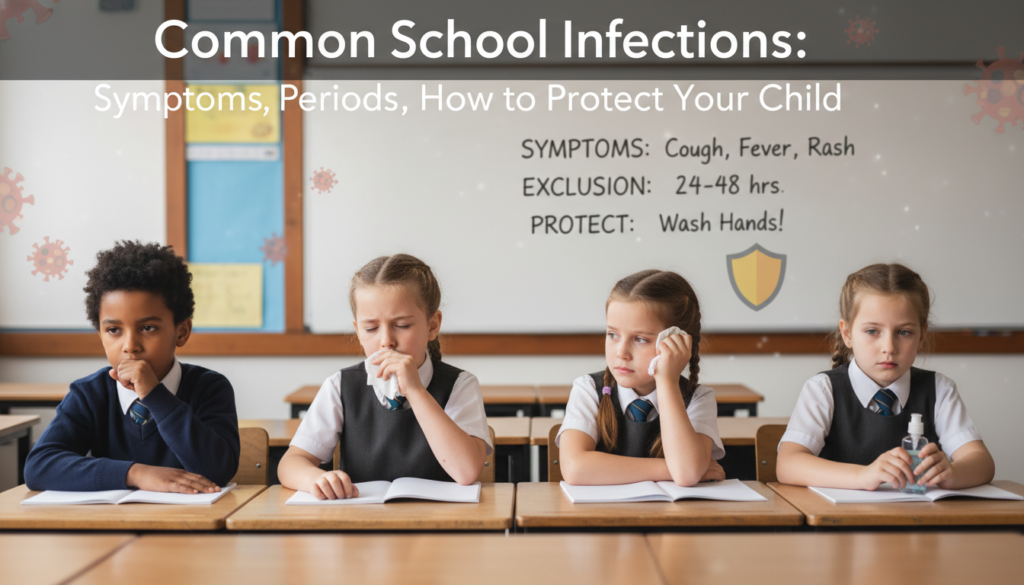
Common School
Infections:
Complete Guide
Everything parents, teachers, and school nurses need to know about childhood infections — symptoms, how they spread, school exclusion periods, treatment, and prevention strategies that actually work.
Schools are among the most efficient environments for spreading infectious disease in any community. A single infected child in a classroom of 30 can transmit a respiratory virus to 15–25 classmates within 48 hours under normal conditions. Understanding why helps parents and schools adopt effective countermeasures.
Close Proximity
Children sit, eat, and play within centimetres of each other for 6+ hours — the ideal distance for respiratory droplet transmission.
Frequent Contact
Shared surfaces — door handles, keyboards, pencils, tablets — are touched hundreds of times per day by dozens of children.
Poor Hand Hygiene
Young children touch their faces an average of 23 times per hour and frequently skip handwashing after toileting and before meals.
Developing Immunity
Children are encountering many pathogens for the first time — they have no pre-existing immunity and are therefore more susceptible and more contagious for longer.
Pre-Symptomatic Spread
Many infections are most contagious 24–48 hours before symptoms appear — children are already spreading illness before parents know they are sick.
Asymptomatic Carriers
Some children carry bacteria like Strep and Staph without symptoms — acting as silent reservoirs that seed repeated outbreaks within the school community.
The following are the infections most frequently circulated in school environments worldwide, complete with key facts every parent and teacher should know.
This is the most searched question parents have about school illness. Use this table to quickly determine when your child can safely return to school. Exclusion periods are based on UK Health Security Agency (UKHSA) and CDC guidance — globally applicable.
| Infection | Exclusion Period | Key Return Criteria | Notifiable? |
|---|---|---|---|
| Norovirus / D&V bug | 48 hours from last symptoms | 48 hrs after last vomiting or diarrhoea — the most important rule in school hygiene | No (report outbreak to school) |
| Chickenpox | Until all spots crusted | Usually 5 days from rash onset. All spots must have scabbed over — not just dried | No (inform school) |
| Strep Throat (Scarlet Fever) | 24 hrs after antibiotics start | Child must also be fever-free and feel well enough to participate | Yes — scarlet fever must be reported |
| Impetigo | 48 hrs after antibiotics start | Or when sores are fully crusted and healed if not using antibiotics | No |
| Conjunctivitis (bacterial) | 24 hrs after antibiotic drops start | Or when discharge has completely stopped (viral pinkeye — no drops needed) | No |
| Hand, Foot & Mouth | Until blisters dry + fever-free | Child must feel well enough and blisters must be dry — typically 5–7 days | No |
| Influenza (Flu) | 24 hrs fever-free without medication | Do not use paracetamol to mask fever to send child back early | No (report cluster to school) |
| Head Lice | No exclusion required | Treat and return next day. Notify class parents discreetly | No |
| Common Cold | No exclusion if well enough | Child can attend if they feel well enough to participate and learn | No |
| Ringworm | No exclusion if treated | Start antifungal treatment and cover the affected area | No |
| Measles | 4 days from rash onset | Extremely serious — notify health authorities. Confirm vaccination status of contacts | Yes — legally notifiable |
| Whooping Cough (Pertussis) | 48 hrs after antibiotics start or 21 days if untreated | Highly dangerous in infants — urgent notification to public health authorities required | Yes — legally notifiable |
| Meningitis (bacterial) | Until clinically recovered | Medical clearance required before return. Contacts may require prophylactic antibiotics | Yes — medical emergency |
The 48-Hour Norovirus Rule Is Non-Negotiable
Norovirus remains highly contagious for 48 full hours after the last episode of vomiting or diarrhoea — even if the child looks and feels completely well. A single child returning 24 hours too early can trigger a school-wide outbreak affecting hundreds of children, staff, and their families. Schools are entitled to refuse re-admission until this period has passed.
Group A Streptococcal (GAS) infection — causing strep throat and scarlet fever — is one of the most important school infections to identify and treat, because unlike viral sore throats, it requires antibiotics to prevent serious complications including rheumatic fever and kidney damage.
How to Tell Strep Throat from a Viral Sore Throat
| Feature | Strep Throat (Bacterial) | Viral Sore Throat |
|---|---|---|
| Onset | Sudden and severe | Gradual, part of a cold |
| Fever | High (>38.5°C / 101°F) | Mild or absent |
| Cough | Typically absent | Usually present |
| Runny nose | Usually absent | Often present |
| Throat appearance | Red, swollen, white patches/pus on tonsils | Red but usually no white patches |
| Neck glands | Swollen, tender | May be mildly swollen |
| Rash | Sandpaper rash = scarlet fever | No rash |
| Treatment | Antibiotics (penicillin/amoxicillin) | Rest, fluids, paracetamol |
Invasive Group A Strep (iGAS) — Watch for Rapid Deterioration
Rarely, Group A Strep causes invasive disease — spreading beyond the throat into the bloodstream, joints, or lungs. Warning signs requiring emergency care: high fever with unusual drowsiness or difficulty waking, severe muscle pain disproportionate to the illness, a rapidly spreading rash or skin that looks bruised or discoloured, difficulty breathing, or deterioration despite antibiotic treatment. Contact emergency services immediately if these develop.
Hand, foot and mouth disease (HFMD) is one of the most common and most frequently searched school infections — particularly among parents of children under 10. Despite its alarming name, it is usually mild and self-limiting, though highly contagious and capable of causing school-wide outbreaks.
- Cause: Caused by Coxsackievirus A16 and Enterovirus A71 (EV-A71) — both members of the enterovirus family. EV-A71 strains can occasionally cause more serious neurological complications.
- Typical progression: Fever for 1–2 days → painful sores in the mouth (making eating and drinking difficult) → flat red spots and blisters appearing on the palms, soles, and sometimes buttocks and genitals over days 3–5
- Pain management: Paracetamol or ibuprofen for fever and mouth pain. Cold fluids, ice lollies, and soft foods help with oral sores. Ensure adequate hydration — the main risk in young children is dehydration from reduced drinking due to mouth pain.
- Adults can catch it too: Adults can contract HFMD from infected children, though the illness is typically milder. Pregnant women should avoid close contact with infected children and consult their midwife if exposed, as enterovirus infection in pregnancy carries a small risk.
- No specific treatment: There is no antiviral medication for HFMD. Supportive care (hydration, pain relief) is the only management. Most children recover fully within 7–10 days.
- Not the same as foot-and-mouth disease in animals: A very common parental concern. Human HFMD and foot-and-mouth disease in cattle and pigs are caused by completely different viruses and cannot cross species. Cats and dogs cannot transmit or catch human HFMD.
Conjunctivitis — inflammation of the membrane covering the white of the eye and inner eyelid — is one of the most common conditions in school-age children. It spreads rapidly in classrooms due to frequent eye-touching and shared surfaces.
| Type | Appearance | Discharge | Treatment | Contagious? |
|---|---|---|---|---|
| Bacterial | Red, swollen eyelids | Yellow/green, sticky — lids stuck together on waking | Antibiotic eye drops (chloramphenicol) | Yes — until 24hrs on drops |
| Viral | Pink, watery eye(s) | Clear, watery — associated with cold symptoms | No treatment — self-resolves in 1–2 weeks | Yes — while discharge present |
| Allergic | Both eyes, very itchy | Clear, watery — with hayfever symptoms | Antihistamine drops, avoid allergen | Not contagious |
Preventing Conjunctivitis Spread in Schools
Teach children not to rub their eyes. Ensure individual use of towels and face cloths. Disinfect shared surfaces such as classroom tablets and doorknobs. Children with conjunctivitis should avoid touching their eyes, wash hands frequently, and not share eye drops, glasses, or pillows with siblings at home.
Norovirus is the most common cause of gastroenteritis (vomiting and diarrhoea illness) globally and the infection most likely to cause a school-wide outbreak. Its extreme contagiousness — a dose of just 18–20 viral particles is enough to cause infection, and a single episode of vomiting releases billions — makes it uniquely disruptive in school settings.
- Incubation period: 12–48 hours from exposure to symptom onset — children can be exposed at school and become ill at home that night or the next day
- Duration: Most children recover within 1–3 days. Illness lasting more than 3 days, or with blood in the stool, requires medical review
- The 48-hour rule: Children must not return to school for 48 full hours after the last episode of vomiting or diarrhoea — this is the most evidence-based and non-negotiable exclusion period in school health
- Hydration is the priority: Give small, frequent sips of water or oral rehydration solution. Avoid sugary drinks and undiluted fruit juice. Solid food can be reintroduced when the child feels ready — there is no need to fast
- Cleaning after an episode: Norovirus is resistant to many common household disinfectants. Use bleach-based products (1,000 ppm available chlorine) to clean hard surfaces after vomiting. Remove and wash soiled clothing and bedding at 60°C immediately. Open windows for ventilation
- Hand gel is insufficient: Alcohol-based hand gels do not reliably kill norovirus. Thorough soap-and-water handwashing for 20 seconds is required — particularly after toileting and before handling food
Head lice are among the most common childhood conditions worldwide and consistently cause parental anxiety disproportionate to the actual risk — lice do not transmit disease, but they do cause intense social stigma that makes families reluctant to report and treat them, allowing outbreaks to persist.
Head Lice Cannot Jump or Fly
This is the most important fact to understand: head lice can only spread by direct head-to-head contact. They cannot jump, fly, or live on hats, pillowcases, or seats for more than a few hours away from a human scalp. School closures and class exclusions for head lice are not recommended by any public health authority — they do not reduce transmission and cause unnecessary disruption.
How to Treat Head Lice — Step by Step
- Confirm the diagnosis: Use a fine-toothed detection comb on wet, conditioned hair. Live lice are tan-grey, sesame-seed sized, and move quickly. Nits (eggs) are white-grey specks glued to hair shafts within 1cm of the scalp — unlike dandruff, they do not brush off easily
- Treat only confirmed cases: Do not treat prophylactically — this encourages resistance. Treat everyone in the household with confirmed live lice on the same day
- Recommended treatments: Dimeticone 4% lotion (Hedrin) or malathion 0.5% — these work by physically or chemically killing lice. Apply as directed, leave on for the specified time, then comb through with a nit comb. Repeat after 7 days to catch hatching nits
- Wet combing (conditioner method): Apply conditioner to wet hair, section carefully, and comb from root to tip with a detection comb every 3–4 days for 2 weeks. Effective when done consistently — a non-chemical alternative suitable for all ages
- No need to wash bedding at high temperature: Lice cannot survive off the scalp for more than a few hours. Normal laundering is sufficient
Impetigo is a highly contagious bacterial skin infection — the most common skin infection in children — caused by Staphylococcus aureus or Streptococcus pyogenes. It is particularly common in pre-school and primary school children, especially in warm weather when minor skin abrasions are more frequent.
- Appearance: Starts as small red sores or blisters — most commonly around the nose and mouth — that burst quickly and leave raw areas covered by the distinctive golden-yellow (honey-coloured) crust that gives impetigo its characteristic appearance
- Not dangerous in healthy children: Impetigo is uncomfortable and contagious but rarely causes serious illness in healthy children. In rare cases it can cause post-streptococcal glomerulonephritis (kidney complication) — another reason to treat promptly
- Treatment: Small areas — topical antibiotic cream (fusidic acid or mupirocin) applied 3 times daily for 5–7 days. Widespread impetigo — oral antibiotics (flucloxacillin or cefalexin) for 5–7 days. Always prescribed by a doctor
- Prevent spreading within the family: Use separate towels and flannels. Do not share pillowcases. Keep nails short. Discourage scratching. Wash hands before and after applying cream. Cover sores loosely with a non-stick dressing
- MRSA impetigo: Cases that fail to improve with first-line antibiotics should be reviewed — MRSA (methicillin-resistant Staph aureus) requires different antibiotic treatment confirmed by wound swab culture
Influenza (flu) and respiratory syncytial virus (RSV) are the two most clinically significant respiratory viruses circulating in schools each winter — both capable of causing severe illness in vulnerable children and spreading infection into homes where high-risk adults and infants live.
| Feature | Influenza | RSV | Common Cold |
|---|---|---|---|
| Typical age | All ages; more severe in under-5s | Most severe in under-2s; common in all | All ages |
| Onset | Sudden and dramatic | Gradual over 2–4 days | Gradual |
| Fever | High (38.5–40°C) | Mild to moderate | Mild or absent |
| Cough | Dry, harsh | Wet, wheeze — can cause bronchiolitis in infants | Present |
| Body aches | Severe | Mild | Mild |
| School exclusion | Until fever-free 24hrs | Until fever-free and well enough | Not required if well enough |
| Prevention | Annual flu vaccine (available for children 2–17 in many countries) | Palivizumab for high-risk infants; RSV maternal vaccine now available | Hand hygiene |
Children’s Flu Vaccine — Protect the Whole Family
In many countries (UK, US, Australia), the annual influenza vaccine is recommended for all children aged 2–17. School-age children are the primary drivers of household flu transmission — vaccinating children protects not just the child, but grandparents, immunocompromised family members, and infants too young to be vaccinated. The nasal spray flu vaccine is available in most settings and takes seconds to administer.
Knowing which infections peak at which time of year helps parents and school nurses prepare, stock appropriate supplies, and spot early outbreaks before they escalate.
Most school infections can be significantly reduced — though not eliminated — through consistent evidence-based prevention measures. These are grouped by who is responsible for implementing them.
For Parents at Home
Handwashing Routine
Teach children to wash hands with soap for 20 seconds after the toilet, before meals, and after blowing their nose. This single habit prevents more infections than any medication.
Keep Vaccinations Up to Date
Ensure MMR (measles, mumps, rubella), chickenpox, flu, and meningitis vaccines are current. Check your child’s vaccination record annually before the school year starts.
Nutrition & Sleep
Adequate sleep (9–12 hours for school-age children) and a balanced diet rich in vitamins C, D, and zinc support immune function and reduce infection severity.
Keep Sick Children Home
The single most impactful community action: keep unwell children home at the first signs of fever or illness. Do not send a child to school with a fever under any circumstances.
No Sharing of Personal Items
Water bottles, hats, combs, lip balm — all regularly shared at school. Reinforce daily that these are personal items not to be shared with classmates.
Teach Cough Etiquette
Cough and sneeze into the elbow (“vampire sneeze”), not the hand. This dramatically reduces the amount of virus deposited onto surfaces that other children touch.
For Schools
- Ensure soap, paper towels, and functional sinks are consistently available in all toilets and near canteen areas — infrastructure that children will actually use
- Implement regular high-touch surface disinfection: door handles, keyboards, tablets, and shared stationery — minimum daily, more frequently during outbreak periods
- Train all staff to recognise signs of common infections and to enforce exclusion periods without exception or parental pressure
- Maintain good indoor ventilation — CO₂ monitors in classrooms allow objective monitoring of air quality and prompt ventilation when levels rise
- Establish a clear, written infection control policy shared with all families at the start of the school year — so exclusion decisions are never seen as arbitrary
- Communicate early and transparently when an outbreak is detected — early parental awareness enables faster action and reduces overall spread
Most school infections in healthy children are self-limiting and do not require a GP visit. However, certain signs in a sick child warrant prompt medical attention.
Go to Emergency / Call an Ambulance If Your Child Has:
Difficulty breathing or rapid laboured breathing · A rash of small red or purple spots that do not fade when pressed (petechial/purpuric rash — possible meningitis) · Extreme difficulty waking or unusual limpness · High-pitched unusual crying in an infant · Bulging fontanelle (soft spot) in a baby · Lips or fingertips turning blue · Seizure for the first time or lasting more than 5 minutes
See Your GP Within 24–48 Hours If:
Fever persists more than 5 days · Child is under 3 months with any fever · Ear pain with fever (possible otitis media) · Severe sore throat without cold symptoms (possible strep) · Signs of dehydration — no urination for 8+ hours, dry mouth, no tears when crying · Worsening rash · Skin infection spreading or not improving with treatment · School-age child with symptoms suggesting whooping cough (paroxysmal coughing fits followed by “whoop”)
Prepared Parents,
Healthier Schools.
No child will avoid every school infection — and that is a healthy part of immune development. But knowing the signs, the exclusion rules, and the right time to seek help makes all the difference between a minor illness and a missed complication.
Bookmark this guide at the start of every school year — and share it with your school community.
⚕️ Medical Disclaimer: This guide is for informational and educational purposes only. It does not replace professional medical advice or a formal consultation with a doctor. Always consult a qualified healthcare professional for diagnosis and treatment of specific illnesses. In emergencies, call your local emergency services immediately.
📌 SEO Reference — Full Keyword Research Included
Post Title: Common School Infections: Symptoms, Exclusion Periods & How to Protect Your Child
Meta Description: A complete parent’s guide to common infections spread in schools — strep throat, hand foot and mouth, pink eye, chickenpox, norovirus, head lice & more. Includes school exclusion period table, treatment, and prevention tips.
Slug: common-school-infections-guide
Focus Keyword: common infections in schools
SEO notes: “When can my child return to school” and “school exclusion periods” are the highest-intent searches parents make during illness — the exclusion table in Section 3 is specifically structured for featured snippet capture. “Child keeps getting sick from school” is a high-volume emotional search with very few quality answers — Section 12 and the FAQ directly address this. Seasonal search volume spikes in September (back to school) and January (flu season) — consider updating and republishing at those times.