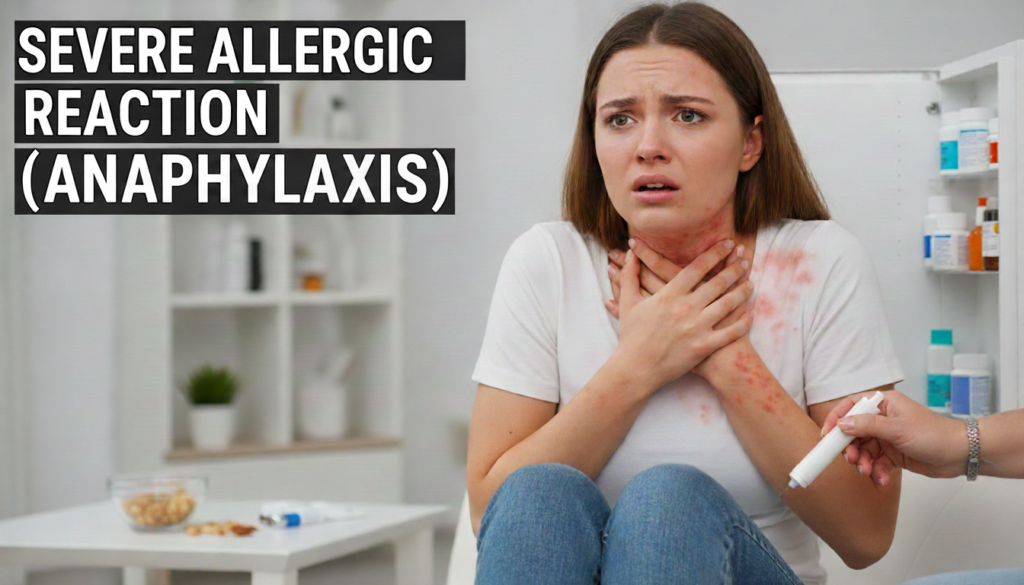
Severe Allergic
Reaction
(Anaphylaxis)
A complete, globally applicable guide to recognising, treating, and surviving anaphylaxis — from first symptoms to EpiPen use, biphasic reactions, and long-term management.
Anaphylaxis is a severe, rapid-onset, life-threatening systemic allergic reaction that affects multiple organ systems simultaneously. It occurs when the immune system overreacts to an allergen — a substance it has mistakenly identified as dangerous — releasing a massive surge of immune chemicals, primarily histamine and tryptase, that cause blood vessels to dilate, blood pressure to plummet, airways to narrow, and tissues to swell.
Unlike a mild allergic reaction (hives, sneezing, watery eyes), anaphylaxis can be fatal within minutes if not treated promptly with epinephrine (adrenaline). It is one of the few medical emergencies where a single injection of the right medication, given fast enough, can be the difference between life and death.
How Common Is It?
Anaphylaxis affects an estimated 1 in 50 people at some point in their lifetime and is rising globally, particularly in high-income countries. Food allergy–related anaphylaxis has increased by over 300% in the past two decades. Despite this, fatalities remain relatively uncommon — because most deaths are preventable with correct, timely treatment.
Anaphylaxis symptoms typically appear within seconds to 30 minutes of exposure to the trigger — though delayed onset up to several hours is possible (especially with food triggers). Symptoms develop rapidly across multiple body systems simultaneously, which distinguishes it from an ordinary allergic reaction.
Airway (Most Dangerous)
Throat swelling, hoarse voice, stridor (high-pitched breathing sound), difficulty swallowing, sensation of throat closing. Can lead to complete airway obstruction within minutes.
Breathing
Wheezing, shortness of breath, chest tightness, rapid breathing. Bronchospasm — narrowing of the airways — causes the classic asthma-like wheeze of anaphylaxis.
Cardiovascular
Rapid weak pulse, sudden drop in blood pressure (hypotension), dizziness, collapse, and loss of consciousness. Distributive shock can develop within minutes.
Skin (Most Common)
Widespread hives (urticaria), flushing, itching, and swelling — particularly of the face, lips, and eyelids (angioedema). Skin symptoms appear in ~90% of anaphylaxis cases.
Gastrointestinal
Nausea, vomiting, stomach cramps, and diarrhoea — especially in food-triggered anaphylaxis. GI symptoms alongside skin and respiratory features strongly indicate anaphylaxis.
Neurological
Sense of impending doom (a classic, often-dismissed warning sign), confusion, anxiety, headache, and loss of consciousness as blood pressure falls and cerebral perfusion drops.
“Sense of Impending Doom” Is a Real Medical Symptom
A sudden, unexplained overwhelming feeling that something terrible is about to happen — often described as “I felt like I was going to die” — is a neurological symptom of anaphylaxis caused by massive histamine release and falling blood pressure. It is a recognised early warning sign that should prompt immediate action, not reassurance.
Anaphylaxis Without Skin Symptoms
Critically, approximately 10–20% of anaphylaxis cases have no skin symptoms at all. This is particularly common in insect venom anaphylaxis and in cases presenting primarily as cardiovascular collapse. The absence of hives or swelling does not rule out anaphylaxis — if multiple other systems are involved rapidly after allergen exposure, treat as anaphylaxis.
One of the most searched questions about this topic — and one of the most important to answer correctly. Understanding this difference can determine whether someone receives antihistamines (inadequate for anaphylaxis) or epinephrine (essential for anaphylaxis).
✓ Mild/Moderate Allergic Reaction
- Hives or rash localised to one area
- Runny nose, sneezing, watery eyes
- Itching of skin, eyes, or mouth
- Mild stomach upset
- Symptoms stay localised — one body system
- No breathing difficulty
- No drop in blood pressure
- Person feels unwell but is alert and stable
- Responds well to antihistamines
⚠ Anaphylaxis — Severe Reaction
- Rapidly spreading hives across the whole body
- Swelling of lips, tongue, or throat
- Hoarse voice or difficulty speaking
- Wheezing or severe shortness of breath
- Multiple body systems affected simultaneously
- Dizziness, collapse, or loss of consciousness
- Weak, rapid pulse — blood pressure falling
- Nausea/vomiting alongside other symptoms
- Requires epinephrine — NOT just antihistamines
Antihistamines Do Not Treat Anaphylaxis
This is perhaps the most dangerous misconception in allergy management. Antihistamines (cetirizine, loratadine, diphenhydramine) act too slowly and on too few pathways to reverse anaphylaxis. They block only histamine — not the bradykinin, leukotrienes, and prostaglandins also driving the reaction. Only epinephrine (adrenaline) rapidly reverses all components of anaphylaxis. Giving antihistamines first fatally delays epinephrine in many deaths from anaphylaxis.
Any substance that triggers an allergic response can theoretically cause anaphylaxis. However, certain categories are responsible for the vast majority of cases worldwide. Identifying your personal trigger is essential for prevention and emergency planning.
Triggers by Frequency
| Trigger Category | Most Common Specific Triggers | Age Group Affected Most | Frequency |
|---|---|---|---|
| Food | Peanuts, tree nuts (cashew, walnut), shellfish, fish, milk, eggs | Children & young adults | Very Common |
| Insect Venom | Bee sting, wasp sting, fire ant | Adults, outdoor workers | Common |
| Medications | Beta-lactam antibiotics (penicillin), NSAIDs, aspirin, IV contrast | Adults | Common |
| Latex | Surgical gloves, catheters, balloons | Healthcare workers, surgical patients | Occasional |
| Exercise | Running, cycling — alone or with cofactors | Young active adults | Rare |
| Biological agents | Monoclonal antibodies, vaccines, blood products | Adults in medical settings | Rare |
Cofactors That Increase Anaphylaxis Severity
Several factors amplify the severity of a reaction even to a familiar allergen: exercise (especially within 2–4 hours of eating), alcohol consumption, NSAIDs (ibuprofen, aspirin), acute infection, menstruation, stress, and poorly controlled asthma. People with known food allergies should be aware that these cofactors can turn a previously tolerated exposure into a life-threatening reaction.
An EpiPen (epinephrine auto-injector) is the primary, life-saving treatment for anaphylaxis. Epinephrine reverses all components of anaphylaxis simultaneously: it constricts blood vessels (raising blood pressure), relaxes airway muscles (opening the bronchi), reduces swelling, and suppresses further immune mediator release. Knowing how to use one correctly — and fast — saves lives.
Remove the EpiPen from its carrier and take off the blue safety cap
Pull the blue (or grey) safety cap straight off — do not twist. Hold the EpiPen firmly in your dominant hand with your thumb closest to the orange tip. Never put your thumb over the orange tip — that is where the needle exits.
Inject into the outer mid-thigh — through clothing if necessary
Press the orange tip firmly against the outer mid-thigh (not the inner thigh, not the buttock) at a 90-degree angle. Hold firm pressure until you hear a click — this confirms injection. You can inject through clothing — do not waste time removing trousers.
Hold for 10 full seconds, then remove and massage
Maintain firm pressure for 10 seconds to ensure complete medication delivery. Remove the EpiPen carefully and massage the injection site for 10 seconds to help distribute the epinephrine into the tissue.
Call emergency services immediately — even if symptoms improve
Call emergency services (911 / 999 / 112) right away. Epinephrine wears off in 15–20 minutes. All patients must be monitored in hospital for at least 4–6 hours due to the risk of biphasic anaphylaxis — a second wave of reaction that can be as severe or worse than the first.
Second EpiPen if no improvement after 5 minutes
If symptoms are not clearly improving within 5 minutes, give a second EpiPen into the opposite thigh. Most patients will need only one dose; however, a second auto-injector should always be available. Give the used EpiPen to paramedics on arrival.
EpiPen Maintenance — Three Things to Check Regularly
1. Expiry date: Check every 3 months — expired epinephrine is less effective. 2. Clarity: The solution should be clear and colourless — discard if discoloured or cloudy. 3. Storage: Store at room temperature (15–30°C) — never in a car glove box or fridge. Heat and cold degrade epinephrine faster than anything else. Replace immediately after use and after any expiry.
Whether you are the person experiencing the reaction or a bystander, the following sequence of actions — performed in the right order — gives the best chance of a good outcome.
- Recognise it early: If multiple systems are affected rapidly after known allergen exposure — skin + breathing, or skin + cardiovascular — assume anaphylaxis and act immediately. Do not wait for all symptoms to appear.
- Inject epinephrine first: Use the EpiPen immediately — into the outer thigh, through clothing if needed. Epinephrine is the only treatment that matters in the first minutes. Everything else is secondary.
- Call emergency services: Call 999 / 911 / 112 immediately after injecting. Tell them it is an anaphylaxis emergency. Stay on the line for guidance.
- Position correctly: If conscious and breathing — lay flat with legs elevated (raises blood pressure). If breathing is difficult — allow to sit up. If unconscious and breathing — recovery position. If not breathing — begin CPR.
- Remove the trigger if possible: Brush off insect stingers (scrape sideways — do not squeeze), stop any IV infusion, spit out or remove food if just eaten. Do not induce vomiting.
- Second EpiPen at 5 minutes if needed: If no clear improvement after 5 minutes and a second auto-injector is available, use it in the opposite thigh.
- Do not leave the person alone: Anaphylaxis can deteriorate very rapidly. Stay with them, keep them calm, and monitor breathing and consciousness until emergency services arrive.
- Go to hospital — even after recovery: Never allow someone who has had anaphylaxis to go home, even if they feel better after epinephrine. Biphasic reactions can occur 1–72 hours later.
Understanding the biology of anaphylaxis helps explain why speed of treatment is so critical — and why the reaction escalates so quickly without intervention.
Allergen Detected — IgE Antibodies Activate
Mast cells and basophils armed with allergen-specific IgE antibodies recognise the trigger. Cross-linking of IgE molecules triggers immediate degranulation — the rapid release of pre-formed chemical mediators into the bloodstream.
Histamine Flood — Vessels Dilate, Tissues Swell
Histamine, tryptase, and other mediators cause massive vasodilation (blood vessels widen), increased vascular permeability (fluid leaks out of vessels into tissues — causing swelling), and bronchoconstriction (airway muscles contract). Blood pressure begins to fall.
Cardiovascular Collapse Develops
Up to 35% of circulating blood volume can shift from vessels into tissues within 10 minutes. Cardiac output falls, blood pressure drops dangerously, heart rate rises to compensate. Cerebral perfusion falls — confusion and loss of consciousness can follow rapidly.
Secondary Mediators — Sustained Reaction
Leukotrienes, prostaglandins, and platelet-activating factor (produced in the delayed phase) sustain and amplify the reaction. These take longer to develop but are harder to reverse with antihistamines — explaining why patients who appear to improve can deteriorate again.
Epinephrine Reversal — Within 60–90 Seconds
Epinephrine acts on alpha-1 receptors (vasoconstriction — raises BP), beta-1 receptors (increases heart rate and contractility), and beta-2 receptors (bronchodilation). It also stabilises mast cells, reducing further mediator release. Relief is typically rapid but temporary — lasting 15–20 minutes.
Biphasic anaphylaxis is a second wave of anaphylactic symptoms that occurs after an apparent recovery from the initial reaction — with no further allergen exposure. It is one of the most important and least understood aspects of anaphylaxis management, and the primary reason all anaphylaxis patients must be observed in hospital even after they feel better.
- How common is it? Biphasic reactions occur in approximately 1–20% of anaphylaxis cases, with most estimates around 5–10%. The wide range reflects different definitions and study populations.
- When does it occur? Most biphasic reactions develop 1–12 hours after the initial reaction, though cases have been reported up to 72 hours later. The unpredictability of timing is why observation periods are standardised rather than symptom-based.
- Is it as severe? Biphasic reactions can be equal to or more severe than the initial reaction — and they often occur when the patient is home, alone, and without access to epinephrine. This is why biphasic reactions carry higher mortality than initial reactions.
- Who is at higher risk? Risk factors for biphasic anaphylaxis include: severe initial reaction, delayed epinephrine administration, unknown trigger, and reactions to food allergens. Early use of corticosteroids in the hospital may reduce (but does not eliminate) biphasic risk.
- Standard observation period: Most allergy guidelines recommend hospital observation for a minimum of 4–6 hours after anaphylaxis, and up to 24 hours for severe reactions, reactions with cardiovascular collapse, or when the trigger is unknown.
Never Go Home Until a Doctor Clears You
The most dangerous decision after anaphylaxis is leaving hospital or refusing hospital transport because “I feel fine now.” Epinephrine wears off in 15–20 minutes. The biphasic reaction can occur hours later, far from medical help. Every person who has experienced anaphylaxis must be evaluated and observed by medical professionals, regardless of how well they feel after epinephrine.
Once in hospital, anaphylaxis management follows a structured protocol designed to stabilise the patient, prevent biphasic reactions, and begin the process of long-term allergy management.
| Treatment | Purpose | Timing |
|---|---|---|
| IM Epinephrine (adrenaline) | First-line reversal of anaphylaxis — all components simultaneously | Immediately — repeat every 5–15 min if needed |
| Intravenous fluids | Replace fluid that has shifted out of vessels, restore blood pressure | Immediately for hypotension — rapid bolus |
| Oxygen therapy | Correct hypoxia from bronchospasm and cardiovascular compromise | Immediately — high-flow via mask |
| Antihistamines (H1 + H2) | Adjunct only — reduce skin symptoms and GI symptoms | After epinephrine — never instead of it |
| Corticosteroids (hydrocortisone) | May reduce biphasic reaction risk; treat prolonged symptoms | After initial stabilisation |
| Nebulised salbutamol | Additional bronchodilation if persistent wheeze remains | If bronchospasm persists after epinephrine |
| Observation 4–24 hours | Biphasic anaphylaxis monitoring and safety | Throughout hospital stay |
| Allergy referral letter | Document trigger, refer for testing and long-term management | Before discharge |
Anaphylaxis Recovery Time
With prompt treatment, most people recover fully from anaphylaxis within 24–48 hours. However, recovery varies significantly by severity: mild cases may feel completely normal within hours, while severe reactions involving cardiovascular collapse can take several days of recovery. Fatigue, headache, and a general feeling of being “washed out” are common in the 24–48 hours after anaphylaxis as the body recovers from the massive physiological stress.
Children represent a disproportionately high proportion of anaphylaxis cases — largely driven by the global rise in food allergies. Managing anaphylaxis in children requires special considerations around EpiPen sizing, school protocols, and age-appropriate allergen avoidance education.
EpiPen Dosing by Weight
EpiPen Jr (0.15mg): children 15–30 kg. EpiPen (0.3mg): children over 30 kg and adults. Consult your doctor — some children over 20 kg may use the adult dose. Never under-dose; it is safer to use the adult pen than none.
School & Childcare
Every child with known anaphylaxis risk should have a written Anaphylaxis Action Plan at school, two EpiPens kept accessible (not locked away), and trained staff who know how and when to use them.
Food Allergy in Children
Peanut, tree nut, milk, and egg allergies are the leading triggers in children. Many children outgrow milk and egg allergies; peanut and tree nut allergies are more persistent. Annual review with an allergist is recommended.
Recognising in Young Children
Young children cannot describe throat tightness or a sense of doom. Watch for: sudden change in voice, drooling (difficulty swallowing), unusual crying, clawing at face or throat, sudden drowsiness, or rapid change in skin colour.
For people with known anaphylaxis risk, prevention, preparedness, and long-term specialist care are the cornerstones of safe daily life. Anaphylaxis does not have to dominate your life — but it does require consistent attention.
- Always carry two EpiPens: Two — not one. If the first fails or a second dose is needed, having only one can be fatal. Keep one accessible at all times; give one to a trusted person when in social settings.
- Wear a medical alert ID: A medical alert bracelet or necklace (or a medical ID app on a locked phone screen) communicates your allergy and EpiPen need to first responders if you are incapacitated.
- Create and share an Anaphylaxis Action Plan: A written personalised plan — signed by your doctor — describing your triggers, symptoms, and treatment steps. Share with family, friends, school, and employers.
- See an allergist for formal allergy testing: Skin prick tests and specific IgE blood tests identify your exact triggers, differentiate genuine allergy from intolerance, and guide avoidance strategies far more accurately than self-diagnosis.
- Ask about allergen immunotherapy (desensitisation): Oral immunotherapy (OIT) for peanut allergy and subcutaneous immunotherapy (SCIT) for insect venom allergy can significantly raise the threshold needed to trigger a reaction — in some cases providing long-term protection. Not appropriate for all patients — discuss with your allergist.
- Read every food label, every time: Food composition changes without notice. “May contain” warnings indicate genuine manufacturing cross-contact risk. When eating out, communicate your allergy clearly and ask how food is prepared.
- Review cofactors with your allergist: Understand which cofactors (exercise, alcohol, NSAIDs, illness) apply to your specific allergy pattern and develop strategies to manage them.
Tryptase Testing — The 60-Minute Window
Serum mast cell tryptase, drawn ideally 30–120 minutes after the onset of suspected anaphylaxis, is the gold-standard biomarker confirming the diagnosis. It is particularly important when the diagnosis is uncertain (e.g. no skin symptoms, history of mastocytosis). If you have attended A&E with a suspected anaphylaxis reaction, ask whether tryptase was measured — it has diagnostic and legal importance.
Prepare Today.
It Saves Lives Tomorrow.
Anaphylaxis gives very little warning and no second chances without the right response. If you or someone you love has a severe allergy — get tested, carry two EpiPens, make a plan, and share this guide.
Knowledge, preparation, and speed are the three things that turn a potential fatality into a full recovery.
⚕️ Medical Disclaimer: This guide is for informational and educational purposes only and does not replace professional medical advice, diagnosis, or treatment. If you or someone near you is experiencing a suspected anaphylaxis reaction, call emergency services immediately. Always consult a qualified allergist or immunologist for personalised allergy management.
📌 SEO Reference — Post Metadata
Title: Severe Allergic Reaction (Anaphylaxis): Symptoms, Causes, Treatment & What To Do
Meta Description: Signs of anaphylaxis, how to use an EpiPen, food and insect sting triggers, biphasic anaphylaxis explained, and what to do immediately during a severe allergic reaction. Medically accurate global guide.
Slug: severe-allergic-reaction-anaphylaxis
Focus Keyword: severe allergic reaction
High-Volume, Low-Competition Keywords: anaphylaxis symptoms signs of anaphylaxis severe allergic reaction symptoms how to use an EpiPen anaphylaxis first aid anaphylaxis treatment allergic reaction swollen throat anaphylaxis vs allergic reaction biphasic anaphylaxis how long does anaphylaxis last anaphylaxis without epipen anaphylaxis recovery time bee sting severe allergic reaction severe allergic reaction to food anaphylaxis causes anaphylaxis in children
SEO notes: “How to use an EpiPen” and “anaphylaxis vs allergic reaction” are high-volume informational queries with relatively low competition — ideal for featured snippet targeting with the structured content above. “Biphasic anaphylaxis” is a low-competition, high-intent keyword rarely covered by general health sites — excellent for capturing specialist traffic.