
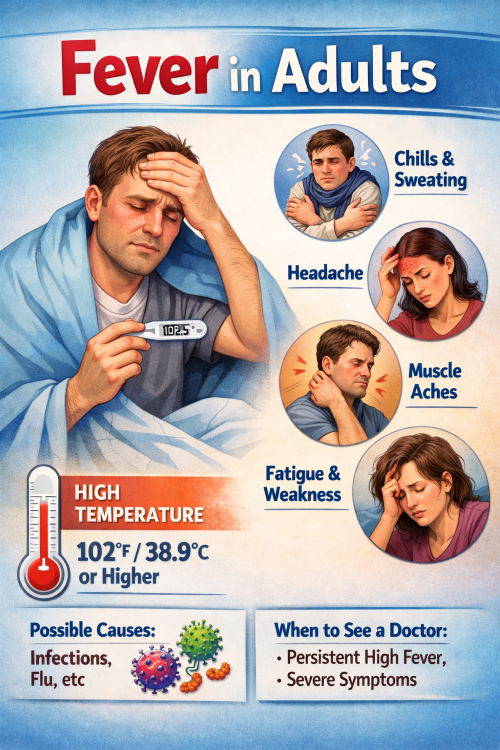
A high fever in adults is one of the top reasons people rush to urgent care. Sometimes it hits suddenly in the middle of the night. Other times, it creeps up slowly throughout the day. Either way, watching the thermometer climb can be stressful.
- What is high fever in adults? A body temperature of 39°C (102.2°F) or higher is considered a high fever. Anything above 40°C (104°F) requires immediate medical attention.
- Most common causes: Viral infections (flu, COVID-19, dengue), bacterial infections (typhoid, pneumonia, UTI), and parasitic infections like malaria.
- What to do immediately: Take a fever reducer like paracetamol or ibuprofen. Hydrate aggressively with water or ORS. Rest in a cool room, and apply a lukewarm damp cloth to your forehead and neck.
- What Temperature Is Considered High Fever in Adults?
- Common Symptoms of High Fever in Adults
- Causes of High Fever in Adults
- Diseases That Cause High Fever in Adults
- How to Reduce Fever in Adults Quickly at Home
- How Long Should a High Fever Last in Adults?
- Fever Only at Night: What Does It Mean?
- When to Worry About High Fever in Adults
- When to See a Doctor
- Frequently Asked Questions
Click any section to jump directly to it.
Here is the truth: a fever is not the enemy. It is your immune system doing exactly what it was designed to do—fighting off an infection. The challenge is knowing when to let it run its course, and when you need to step in.
If you are looking for how to reduce fever quickly, you are in the right place. In this guide, we will break down what is happening in your body, the most likely culprits, and the safest ways to manage your temperature at home.
What Temperature Is Considered High Fever in Adults?
Not all elevated temperatures mean you need medication. In clinical practice, most patients worry the moment they cross 37°C. But your body naturally fluctuates. Here is a clear clinical breakdown of what your thermometer is actually telling you:
| Temperature Range | Severity Level | What to Do |
|---|---|---|
| 36°C – 37.5°C | Normal | No action needed. You are in the healthy range. |
| 37.5°C – 39°C | Mild to Moderate | Rest, increase fluids, and monitor. |
| 39°C+ | High Fever | Start treatment. Seek care if it persists. |
A reading of 40°C (104°F) or above is a very high fever. At this point, your organs are under genuine stress. Don’t wait it out—seek medical care immediately.
Common Symptoms of High Fever in Adults
Fever rarely travels alone. As your body burns energy to fight off an illness, fever symptoms in adults tend to show up as a cluster of systemic warning signs. Patients commonly present with:
Causes of High Fever in Adults
Fever is a symptom, not a standalone disease. Understanding the causes of high fever in adults is the first step toward feeling better. Giving the wrong treatment—like taking leftover antibiotics for a simple viral fever—is a common mistake that can do more harm than good.
In South Asia and Pakistan, seasonal shifts heavily influence these underlying causes. We frequently see spikes in mosquito-borne and waterborne illnesses during the monsoon months.
Diseases That Cause High Fever in Adults
Here is a quick look at the most common specific illnesses that trigger a high fever in adults.
Viral infections
Bacterial infections
Parasitic infections
Non-infectious causes
Serious conditions requiring emergency care
How to Reduce Fever in Adults Quickly at Home
For most people, fever treatment at home adults can safely rely on is straightforward. Here is what actually works to bring your temperature down fast:
In my experience as a physician, the biggest mistake people make at home is under-dosing their paracetamol or not drinking enough fluids. Your body needs water to regulate its temperature. Furthermore, never take leftover antibiotics for a viral fever—it will not help and can cause harm.
How Long Should a High Fever Last in Adults?
How long should a high fever last depends entirely on the root cause.
Most uncomplicated viral fevers peak within 48 hours and gradually fade over 3 to 5 days. Bacterial fevers, on the other hand, rarely resolve without targeted medical treatment like antibiotics.
If your fever lasts more than 3 days without any sign of improvement, it is time for a medical evaluation. You likely need basic blood tests to rule out specific infections like typhoid or malaria.
Fever Only at Night: What Does It Mean?
Having a fever only in night can be incredibly frustrating. While core body temperatures naturally peak in the late evening, a severe nighttime fever pattern is a major red flag.
Tuberculosis (TB) is a classic cause of drenching night sweats and evening temperature spikes. Hidden bacterial infections, abscesses, or autoimmune flare-ups can also cause this pattern. If your fever consistently spikes at night and disappears by morning, do not ignore it. See your doctor.
When to Worry About High Fever in Adults — Danger Signs
When to worry about fever comes down to looking at the whole picture. A temperature of 39°C is deeply uncomfortable, but it’s the accompanying symptoms that dictate the true danger level.
• Temperature above 40°C (104°F) that does not come down with medication
• Stiff neck, severe headache, and sensitivity to light — warning signs for meningitis
• A rash that does not fade when pressed with a glass
• Confusion, disorientation, or altered consciousness
• Difficulty breathing or chest pain
• Inability to keep any fluids down due to severe vomiting
When to See a Doctor
Do not delay medical care if you experience any of the following:
- Your fever reaches 40°C (104°F) or higher.
- The fever lasts for more than 3 days without improvement.
- You experience confusion, extreme lethargy, or hallucinations.
- You have difficulty breathing or persistent chest pain.
- You develop a severe headache accompanied by a stiff neck.
- An unexplained, non-fading skin rash appears.
- You are unable to keep fluids down due to severe vomiting.
Frequently Asked Questions
Clinically, a body temperature of 39°C (102.2°F) or higher is considered a high fever in adults. Anything above 40°C requires immediate emergency care.
Stay hydrated with water and ORS, apply a lukewarm compress to your neck and forehead, rest in a well-ventilated room, and take over-the-counter paracetamol or ibuprofen.
Most standard viral fevers resolve within 3 to 5 days. If your fever lasts longer than 3 days without improvement, you need to consult a doctor.
While 39°C (102.2°F) is a high fever that needs active treatment, it is usually not immediately dangerous for a healthy adult unless it persists for days or is accompanied by severe warning signs like confusion or a stiff neck.
Ordinary physical exhaustion does not directly cause a fever. However, chronic fatigue weakens your immune system, making you much more vulnerable to the infections that do trigger fevers.
A headache itself does not generate a fever. However, many systemic infections cause both at the same time. If you have a severe headache and a high fever with a stiff neck, seek emergency medical attention immediately.
Yes. Nurofen contains ibuprofen, which is highly effective at reducing high body temperatures and relieving the muscle aches associated with fevers.
See a doctor if your temperature hits 40°C, lasts more than 3 days, or if you experience shortness of breath, extreme confusion, or an inability to keep fluids down.
Final Thoughts
Managing a high fever in adults well comes down to two things: knowing what to do at home and knowing when home is no longer the right place to be. The vast majority of fevers respond to paracetamol, ibuprofen, and aggressive hydration within 48 hours. But some fevers are carrying serious infections that will not wait.
Stay hydrated. Take your medications at the correct dose. And pay attention to how you feel overall, not just the number on the thermometer. If something feels seriously wrong, trust that instinct and get it checked.
“When in doubt, get it checked. A blood test today is always better than a worse situation tomorrow.”

Excellent work on this thoughtful article. The site is remarkably reliable and useful.
I enjoyed this good article and its clarity. The site is useful and accessible.